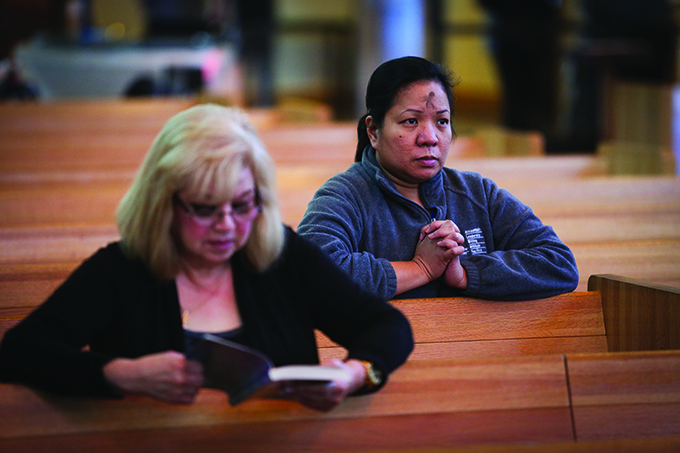
Parishioners pray following Ash Wednesday Mass at St. Michael the Archangel Catholic Church in McKinney on Wednesday, March 1, 2017. (Photo by Kevin Bartram)
By Father Thomas Esposito
Special to The Texas Catholic
Life can bear the stamp of a perpetual Lent for many people, believers and non-believers alike. The desert is the dominant symbol for the church’s annual preparation for Jesus’ Passion, death and resurrection, joining our meditations and mortifications to the Israelites’ 40 years of wandering and Jesus’ own 40 days of temptation.
40 years of wandering and Jesus’ own 40 days of temptation.
But the desert also symbolizes the barrenness of one’s soul, a thirst for something more spiritual and beautiful than the poisoned world can offer, a thirst that for some reason cannot be quenched.
Perhaps a specific sin or addiction keeps one chained in a wasteland devoid of divine manna; perhaps the presence of God is rarely felt or heard due to distractions of superficial cares and noise; perhaps prayer is judged to be impossible because no one seems to be listening.
If you read the book of Ecclesiastes without knowing it is part of the Old Testament, you might think that a jaded 21st century philosopher-businessman wrote it. Its tones of weariness and frustration, as well as an overt sense of futility regarding all things human, could easily proceed from the mouth of a man or woman caught in the contemporary spiritual desert without an exit strategy. Given that Ecclesiastes is so timeless and therefore relevant in its view of “all things under the sun,” it is the perfect book to bother and inspire us this Lenten season.
The author uses the name Qoheleth, a pen name or pseudonym, and also claims to play the role of Solomon, “the son of David, king over Jerusalem.” An unforgettable refrain forms a bookend to the entire work, beginning Qoheleth’s reflections in 1:2 and ending them at 12:8: “Vanity of vanities; all is vanity.”
The term “vanity,” though, is imprecise. Hevel in Hebrew literally means a breath, a puff of smoke, a fleeting cloud. Havel havalim conveys the sense of a vanishing breath, a momentary presence that dissipates and leaves no trace. That, for Qoheleth, is his experience of life. He perceives order and even beauty in the monotonous turning of days, the endless rising and setting of the sun, the coursings of rivers into the ocean, but he cannot grasp why this is so. In attempting to comprehend the rhyme or reason of God’s handiwork, he has no answer, nor does he discern any interest on the part of God in providing an answer.
Like the book of Job and many Psalms, Qoheleth’s reflections are a thorough rebuttal of the pious platitudes and sunny optimism which so often dilute the absolute mystery of God. He asks uncomfortable questions about justice, wisdom, and the link between man and God, and his search has only generated exhaustion. There is a terrible languor in his cold confession, even as the theme of joy in experiencing good things, such as eating and drinking, dots his text.
Christians are tempted to read Ecclesiastes as a model of what life is like without Christ. Qoheleth has no concept of an afterlife, and no apparent hope of a resolution to his apparently absurd experience; his thoughts echo in the heart-chambers of many in our contemporary world. But before jumping to the “thank God for Jesus” conclusion, which is necessary but can easily swerve around the seeming despair of Qoheleth, we must ponder his point. The desert of Lent requires us to confront Qoheleth’s statements about the evanescent nature of existence, the silence of God, and our manifest inability to explain why the world is the way it is. Qoheleth speaks for all of us at various points in our life. His anguished and inspired sentences must indeed generate gratitude in us for the love of God manifest in Jesus Christ, precisely because Qoheleth knows only the absence of God in his life. We must allow his book to provide greater insight into the sufferings of those who want to believe, but fail to see the living and loving God awaiting them on the other side of doubt and death. Carrying the cross of Qoheleth is a blessed Lenten burden for the believer who knows what Christ does with hevel and dust.
Father Thomas Esposito, O.Cist., is a theologian and monk at the Cistercian Abbey of Our Lady of Dallas in Irving. His column appears occasionally in The Texas Catholic.