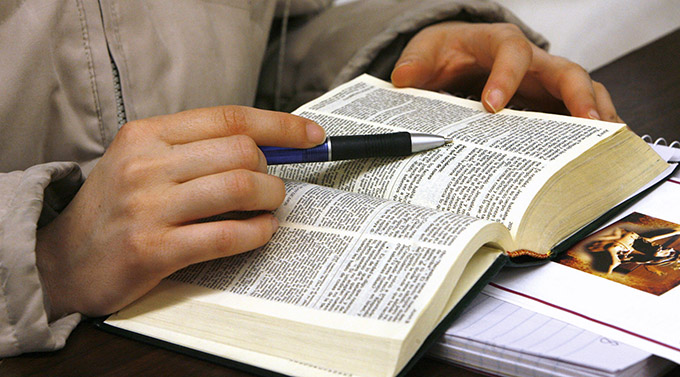
A young woman studies the Bible. (CNS photo/Karen Callaway, Catolico)
By Father John Bayer
Special to The Texas Catholic
“We have come to know and to believe in the love God has for us. God is love, and whoever remains in love remains in God and God in him. In this is love brought to perfection among us, that we have confidence on the day of judgment because as he is, so are we in this world. There is no fear in love, but perfect love drives out fear because fear has to do with punishment, and so one who fears is not yet perfect in love. We love because he first loved us” (1 Jn 4:16-19).
The Bible contains some dense and difficult sentences. For that reason, sometimes they wash over us like the final seconds of a radio commercial. But unlike the final seconds of a commercial, which often serve only to disclose the disadvantages of the advertised product, challenging verses in the Bible promise wisdom and peace to those who listen.
The verses of 1 John 4:16-19 above are a fine example of this. At least at first sight, they could seem like a discouragingly obscure collection of unrelated affirmations, like random stuff in a drawer resistant to every effort of organization. But with a little thought and prayer, we can discover in these verses a most consoling synthesis of Christian faith.
So, in order to understand these verses, I propose we record, replay and ruminate.
Record. Spend three minutes —just 180 seconds — trying to learn these verses by heart. If you are like me, you won’t be able to memorize them. But you will learn something by heart, even if only a word or two. The effort to memorize draws the fullness of our attention to each word.
In a sense, we only really read something when we attend to it with the intensity necessary for memorization, for only then does the particularity of each word and its place become absolutely significant for us.
Replay. Now, set aside the text and spend a few minutes trying to recall these verses. Go for a walk or drink a cup of coffee at your window. Observe peacefully what you remember and how you remember it. Once in a while compare your memory with the text, but keep in mind that what is important here is no longer memorization. What is important is to listen to the words rising from within. What observations or associations come to you as you say the words from your heart rather than pronounce them from a page? When we “recorded” the words they came to us from outside. But as we “replay” them they come from within, sending roots into our own thoughts and feelings. What comes to you as you say in your heart “God is love” or “there is no fear in love”?
Ruminate. Now, after some internalization of these verses, we can begin to chew on them. How do you make sense of them? Here I offer some of my own thoughts.
Perfect love is only possible within an experience of the love God has for us – “We love because God first loved us.” For love requires freedom. Any form of slavery, such as fear, weakens love. The more we fear, the less capable we are for generosity. The more we live to escape punishment, to wipe out our debts and secure our safety, the less we live to offer something unexpected and free – the gift of love.
Those who “have come to know and to believe in the love of God” are purified from fear. They are confident before God, the judge of all, because they believe in his love. Casting themselves on his love, they are confident on “the day of judgment.” No longer living from debt, they are capable of loving freely. In their spiritual life, they waste no time frantically washing their conscience clean by vain attempts at self-justification. Rather, they “remain” in the love of God, peacefully confessing their sins and enjoying the true friendship his love makes possible.
But not only do they “remain” in his love; he also “remains” in them, and to such an extent that “as he is, so are they in this world.” They know God’s love as their own love. For as God is, so are they. By the gift of God, they are capable of “loving first” in the world: they are capable of raising and reconciling, setting others free from their debts and standing them on their feet. As God is, so are they, enabling their neighbors in their own turn to love freely, setting off a chain reaction of grace anchored in God and pulsing through every human heart.
Father John Bayer, O.Cist., is a theologian and monk at the Cistercian Abbey of Our Lady of Dallas in Irving. His column will appear occasionally in The Texas Catholic.